Transnational feminist solidarity activism
Book presentation by Ireen Dubel
- Date
- 13 November 2025
- Time
- 16:00 -18:00
- Location
- IISG, Cruquiusweg 31, Amsterdam
- Organised by
- Ireen Dubel
Encounters at the International Women’s Year Conference in Mexico City inspired the evolvement of women’s rights and gender equality as a field of work that feminist activists, development practitioners, policymakers, politicians and scholars have engaged with around the world. In the Netherlands, the International Women’s Year provided an impetus to the adoption of gender equality as a policy priority in Dutch development cooperation. In 2024, the Schoof cabinet decided to abandon this priority in Dutch foreign and development cooperation policy.
Transnational Feminist Solidarity: Lessons from Dutch Activism and Policy Advocacy (1975–2018)
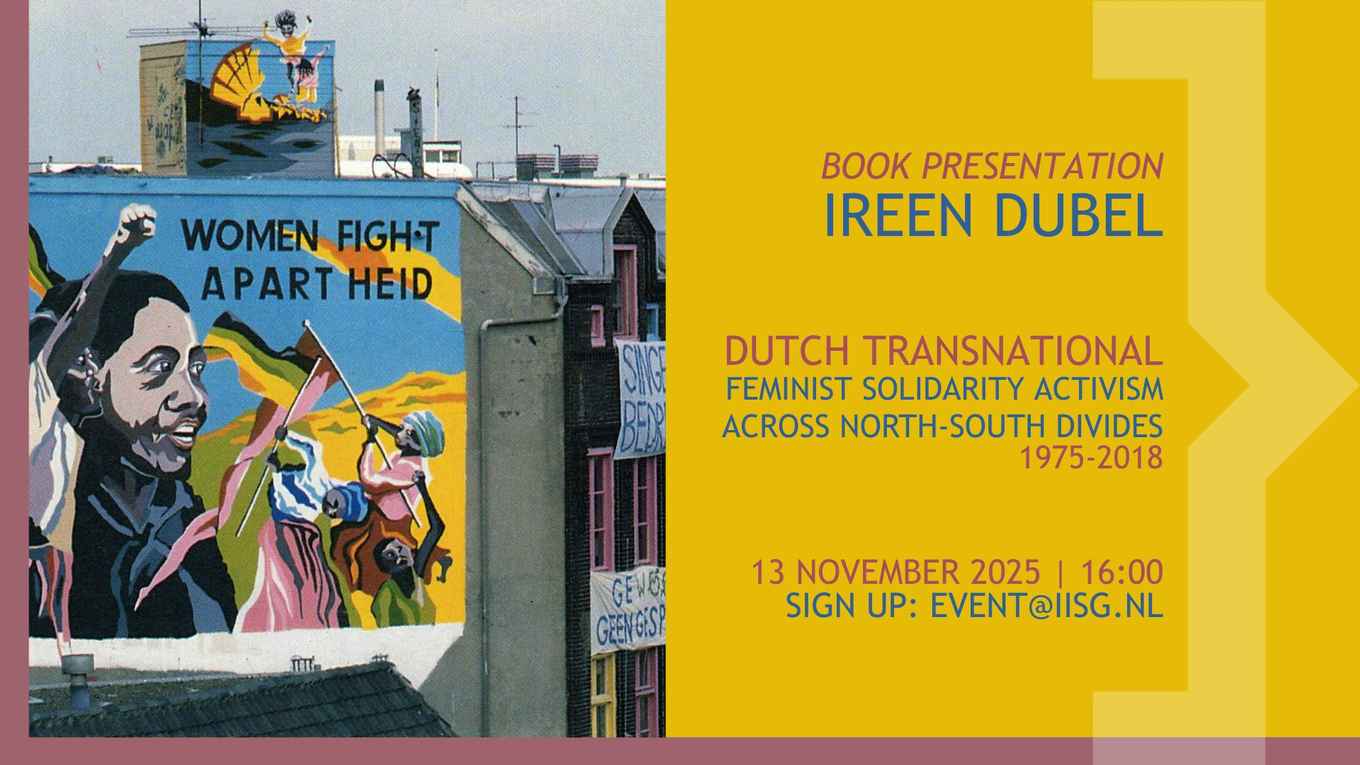
In her book, Ireen Dubel discusses specific case studies of solidarity activism and policy advocacy during the period 1975-2018. These include the agenda-setting of women’s reproductive rights in Dutch and international policy, access to safe abortion activism by Women on Waves, solidarity support to women under apartheid by the women’s group of the Dutch Anti-Apartheid Movement, advocacy on women’s rights and sexual rights at the UN, and mobilisation of political and financial support for women’s movements around the world.
Based on archival research and interviews with key players, as well as first-hand documentation of events and policy claims, Ireen provides evidence for the strategic importance of collaboration between feminist activists and policy advocates from civil society organisations and academia in the Netherlands and the Global South, as well as allies within the Dutch government and among politicians, in order to achieve political success. The history covered in the book has the potential to inspire contemporary and future transnational feminist solidarity engagement.
Roundtable discussion
At the presentation, Ireen will explain the motivation for conducting the multi-year research for the book and highlight some distinct features as well as contentious aspects of the activism that she studied. During a roundtable discussion, Anouka van Eerdewijk, Joke Swiebel, To Tjoelker and Elaine Unterhalter will share their views on the book and their experiences with transnational feminist solidarity activism and feminist policy advocacy.
Programme
- 16.00 – 16.05 Welcome and introduction of the programme by Leontine Bijleveld
- 16.05 – 16.20 Ireen Dubel – The relevance of the research and some unique and contentious features of Dutch transnational feminist solidarity activism during 1975-2018
- 16.20 – 16.35 Presentation of the first copies of the book to: Laetitia van den Assum and Daniëlle Hirsch
- 16.35 – 17.10 Round table discussion with Anouka van Eerdewijk, Joke Swiebel, To Tjoelker and Elaine Unterhalter
- 17.10 – 17.20 Discussion with the audience
- 17.20 – 18.30 Drinks and book sale by Uitgeverij Verloren
Free entrance, more info at The International Institute of Social History