Against Exclusion: Palestinian Citizens in Israel and the Struggle for a Shared Moral and Political Future
Wertheim Lecture 2026
- Date
- 3 March 2026
- Time
- 17:30 -19:00
- Location
- Aula - Lutherse kerk
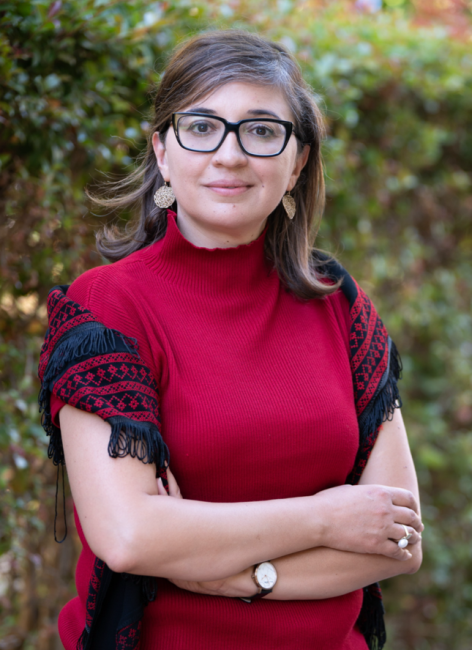
In the Wertheim Lecture 2026, sociologist Dr. Areej Sabbagh-Khoury explores how Palestinian citizens in Israel have used their settler colonial citizenship in generative ways inside a settler-colonial state that was never meant to fully include them. After 1948, Israel granted citizenship to Palestinians who remained not as an act of equality, but as a mechanism of accumulation by dispossession and control over land, population, and political life. Over time, however, Palestinians in Israel have turned this limited and hierarchized citizenship into a tool of anti-colonial political struggle.
Through voting, legal action, grassroots organizing, and public protest, Palestinian citizens have demanded visibility, resources, and political rights, while directly challenging Israel’s definition as an exclusive Jewish state. Their political activism and agency, despite ongoing repression and socio-politicide - sustained sociopolitical destruction - demonstrates that even a deeply compromised form of citizenship can be repurposed to resist settler-colonial rule.
This Wertheim Lecture highlights Palestinian political agency in a context where elimination was “incomplete.” It shows how Palestinians in Israel articulate a forward-looking political vision that challenges Zionism and calls instead for a shared decolonized political future grounded in the dismantling of Jewish supremacy, historical accountability, and justice for both Palestinians and Jewish Israelis.
About the speaker
Areej Sabbagh-Khoury is Assistant Professor of Sociology at the University of California, Berkeley, and Senior Lecturer (equivalent to Associate Professor) in Sociology and Anthropology at the Hebrew University of Jerusalem. Her research focuses on political and historical sociology, settler colonialism, Indigenous studies, and memory.
She is the author of Colonizing Palestine: The Zionist Left and the Making of the Palestinian Nakba (Stanford University Press, 2023), a pioneering sociological study of settler colonialism in Palestine. Based on extensive archival and field research, the book examines how everyday practices of settlement and land appropriation, particularly by kibbutz settlers in northern Palestine, produced enduring structures of racialised hierarchy, violence, and domination before, during, and after 1948.
Sabbagh-Khoury’s work has been published in leading journals including Sociological Theory, Politics & Society, Theory and Society, and Current Sociology. She is currently a fellow of the Netherlands Institute for Advanced Study (NIAS) and has received research grants and fellowships from, among others, the H.F. Guggenheim Foundation, Fulbright, the Palestinian American Research Center, the Israel Science Foundation, and the Council for Higher Education.
She is a member of the General Assembly and Academic Research Committee of Mada al-Carmel – Arab Center for Applied Social Research, co-founder of the Carmel Forum, and a member of Academia for Equality. In May 2021, she co-founded the Emergency Line for students in Israeli universities to support Palestinians facing discrimination.