How to Publish Ethically in a World Dominated by Predatory and Exploitative Academic Publishers
7 January 2026
Let us imagine a researcher named Tim. After ten months of work, Tim has finally completed a draft of his article. He begins searching for publishing houses and academic journals where he might submit it. Although he is satisfied with the draft, he expects to receive constructive feedback to help refine it further. Tim eventually finds a journal — let us call it Cool Ecology — and submits his paper. Two weeks later, he receives an email informing him that his article will be published the following week, provided he pays a fee of 3,000 euros. Tim is taken aback. How could a publisher that normally requires several months to review a submission have assessed his paper so quickly? And why did he not receive the reviewer reports, and were no revisions requested? Tim considers himself is a rigorous researcher, but he certainly does not believe his article is flawless. Sensing that something is not right, Tim begins investigating the journal. He asks colleagues, friends, and other academics for advice. Soon, he reaches an unsettling conclusion: he has likely fallen victim to a predatory journal.
Challenges of publishing ethically
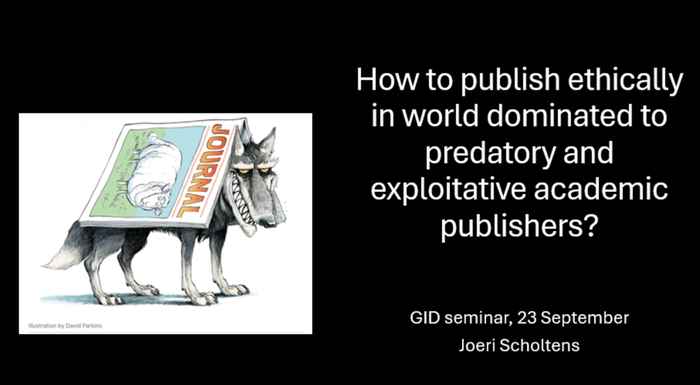
Tim’s experience is neither rare nor insignificant. It reflects a reality that many scholars — especially early-career researchers, who are still becoming familiar with the publication landscape — encounter regularly when attempting to publish their work. This pressing issue motivated Joeri Scholtens to bring the topic to our programme group. In his presentation, he critically examined the challenges of publishing ethically in a landscape increasingly shaped by predatory and exploitative academic practices. He drew attention to the rapid expansion of so-called predatory journals: publishers that exploit the open-access model by charging high fees without offering meaningful peer review or proper editorial oversight. According to some sources, as many as 20,000 journals may fall into this category. Some of these publishers publish hundreds of articles per day, generating vast revenues in the process. Consequently, the academic field is becoming saturated with papers of questionable quality.
Business system
Such a system rewards quantity rather than quality, erodes academic integrity, and sustains a business model in which researchers, reviewers, and editors perform substantial unpaid labour, while publishers secure disproportionately high profits. This is not just the case with predatory journals, though. Also established and respected publishers rely on a remarkably attractive business model of selling the produce of free or state-funded academic labour. Although these publishers are not predatory and uphold acceptable reviewing standards, they are still exploitative, only through more socially sanctioned mechanisms. It is remarkable—if not troubling—how readily the academic community has come to accept such arrangements.
Benevolent ecosystem
Academic publishing is often presented as a neutral, almost benevolent ecosystem where merit, rigour, and the collective advancement of knowledge shape the circulation of ideas. Yet, this picture glosses over a more complex and troubling reality. Researchers invest years of labour in producing high-quality scholarship, while the systems responsible for distributing it frequently operate through extractive, inequitable, and opaque practices. This disconnects between scholarly ideals and publishing realities raises urgent ethical questions about how we contribute to and navigate the current landscape.
Two main tensions
In this sense, there are two main tensions make the current moment especially significant when it comes to fighting predatory publishing. On the one hand, there is a growing awareness across academia that epistemic justice truly matters: many scholars are committed to broadening who produces knowledge and who can access it. Yet, it is also true that we rarely discuss how our own publishing choices reinforce the inequalities we aim to challenge. On the other hand, academics increasingly sense that their labour as authors, reviewers, and editors is being absorbed by commercial publishers whose profits expand precisely because scholarly work is undervalued. As one publisher representative half-jokingly admitted once, academics have become “serfs to the publishing houses”—a remark that captures a discomfort many of us recognise.
Publicly funded research should be publicly accessible
The evolution of open access reveals these contradictions. Its initial promise was straightforward: publicly funded research should be publicly accessible. But as open access became tied to article processing charges (APCs), the financial burden shifted to authors and institutions. Wealthier universities can afford these fees; many others cannot. Instead of democratising knowledge, APC-based open access has created new disparities while funnelling public money into private publishing giants.
Transformative agreements
Even the much-touted ‘transformative agreements’, which tend to be less transformative than their name suggests, have not resolved this dynamic. Rather than challenging publisher dominance, they normalise escalating costs and deepen institutional dependence. In this context, predatory and quasi-predatory journals have flourished. An estimated 15,000–20,000 outlets now operate along this spectrum, incentivised by revenue models that reward volume over quality. High-volume open-access publishers—many of which release hundreds of articles daily and operate with high APCs—illustrate how business models centred on scale and profit can at times compromise the depth of peer review, even if the quality of individual journals varies.
How can scholars publish ethically within structures shaped by profit-driven logics?
Against this backdrop, the seminar raised a central question: how can scholars publish ethically within structures shaped by profit-driven logics? For many, the dilemma is not whether to publish—careers still depend on it—but how to do so without perpetuating extractive and predatory practices. Discussions highlighted practical strategies, such as the Dutch Taverne amendment, and invited participants to view publishing as a political and ethical act rather than a bureaucratic step.
Ultimately, this seminar called for reclaiming agency in a system that often feels opaque and unaccountable. If epistemic justice is to be more than rhetoric, we must collectively rethink how knowledge circulates and how our labour sustains—or challenges—the current publishing landscape.