IMPULSE spotlight: Alana Helberg-Proctor & Bahareh Goodarzi
The Racialization of Care in Dutch Reproductive Healthcare
5 February 2026
Designed to strengthen the academic profiles of early‑career scholars, these grants continue the spirit of the former national instruments. In spring 2025, IMPULSE grants were awarded to Assistant Professors on permanent contracts across all AISSR departments.
Impulse Spotlight
With the selected projects having kicked off in September 2025, the AISSR is now well underway in two years of fresh, innovative research.
In this series, we highlight the researchers behind these projects: what drives their work, why it matters now, and the impact they hope to make.
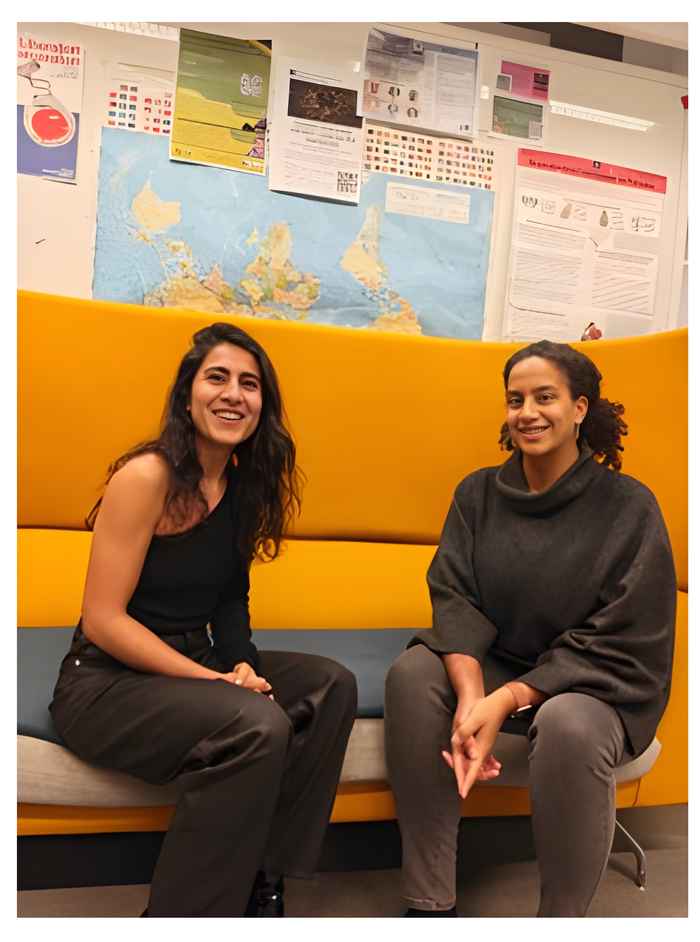
In this edition, we speak with Alana Helberg-Proctor, who used her IMPULSE grant to fund a one-year post-doc, Bahareh Goodarzi, to collaborate with a talented colleague in midwifery science. Their project explores the persistence of race-based healthcare in the Netherlands and its implications for reproductive justice.
In your own words, why is this research especially important at this moment?
'Despite moving away from race-based terminology after World War II, remarkably, this type of categorization is still being used in the Dutch healthcare system', find Alana and Bahareh. The researchers explain that Dutch healthcare professionals are still using race-based frameworks even though ‘race’ is largely absent from public and medical discourse.
'But there remains little critical scrutiny of why this contested concept is used and how it operates in different European contexts', they add. This is the gap their research addresses.
What impact do you hope your project will have within your field and related domains, and for society more broadly?
'We aim to gain a better understanding of how racialization occurs in the Dutch medical context and the consequences of this for patient care', says Alana.
Bahareh explains that Vaginal Birth after Cesarean Section (VBAC) prediction models guide decisions between attempting vaginal birth and opting for a repeat caesarean. Most of these models include “race” or “ethnicity” as variables, yet their use is poorly examined and deeply problematic. These categories act as crude stand-ins for complex social and structural factors, but in practice they are treated as biological traits.
'People categorized as non-Caucasian are unjustly given lower chances of having a VBAC, making them more likely to have an unwarranted caesarean section, a medical intervention with its own risks that is being applied to a group already facing higher rates of illness and death due to ethnic and racial discrimination and social hardships.'
By exposing how these models reproduce inequities in maternity care, the project seeks to support fairer clinical practices and reduce harm among already marginalized groups.

We aim to gain a better understanding of how racialization occurs in the Dutch medical context and the consequences of this for patient care
If you had to explain your research to a non-expert friend at a dinner party, how would you describe it?
'When a person who previously had a C-section gets pregnant again, medical professionals use prediction models to figure out whether they can safely opt for a vaginal delivery or if they have to undergo another C-section. These models ask the patient’s 'race' or 'ethnicity' in a very blunt way, simply asking to respond Yes or No for Caucasian', Alana and Bahareh begin. 'These models treat race as if it's biology', they continue. 'But ‘race’ is just standing in for several other factors: maybe a patient faced discrimination receiving healthcare, has less access to good nutrition, is suffering from the effects of racism, and so on.'
'In essence, our research asks: How are Dutch doctors using ideas of ‘race’ as an assessment tool?'
Looking ahead
Over the next year, Alana and Bahareh will tackle these questions in two research papers, one looking specifically at the VBAC models used in the Netherlands today and the other on the broader history of racialization in a European medical context.
As their work progresses, the researchers aim to expose and challenge the underpinnings of this racialization of care, in order to improve reproductive justice and medical anthropological understanding of racialization in European context.
In essence, our research asks: How are Dutch doctors using ideas of ‘race’ as an assessment tool?
Meet the researchers
Dr. Alana Helberg-Proctor is an interdisciplinary social scientist and Assistant Professor in the Health, Care and the Body program group at the AISSR, department of Anthropology (UvA). Her research examines diversity, (in)equality, and the role of race and ethnicity in healthcare, biomedical research, and health policy within their social, political, and post-colonial contexts.
Trained at The New School, Maastricht University, and with postdoctoral work at UvA and KU Leuven, she has held academic positions across the Netherlands and Belgium and was awarded a Marie Skłodowska-Curie Fellowship in 2021.
In 2025, Alana conducted research for the Dutch Ministry of Health, Welfare and Sport (VWS) on the present-day impact of trans-Atlantic colonial history and slavery on the health of descendants of those who were enslaved and on the Dutch healthcare system. Alana is also part of the KMK consortium researching the colonial history of the Royal Netherlands Academy of Arts and Sciences (KNAW).
Dr. Bahareh Goodarzi holds a PhD (2023) for her dissertation on risk selection in maternal and newborn care and has an academic background in Health Management alongside professional training as a midwife. She is currently a postdoctoral researcher in the AISSR program group Health, Care and the Body programme group at the UvA Anthropology department.Her work focuses on critical reproductive justice.