Introducing the Amsterdam Programme: eight PhD projects addressing Amsterdam's societal challenges
An interview with Doutje Lettinga & Justus Uitermark
29 June 2026
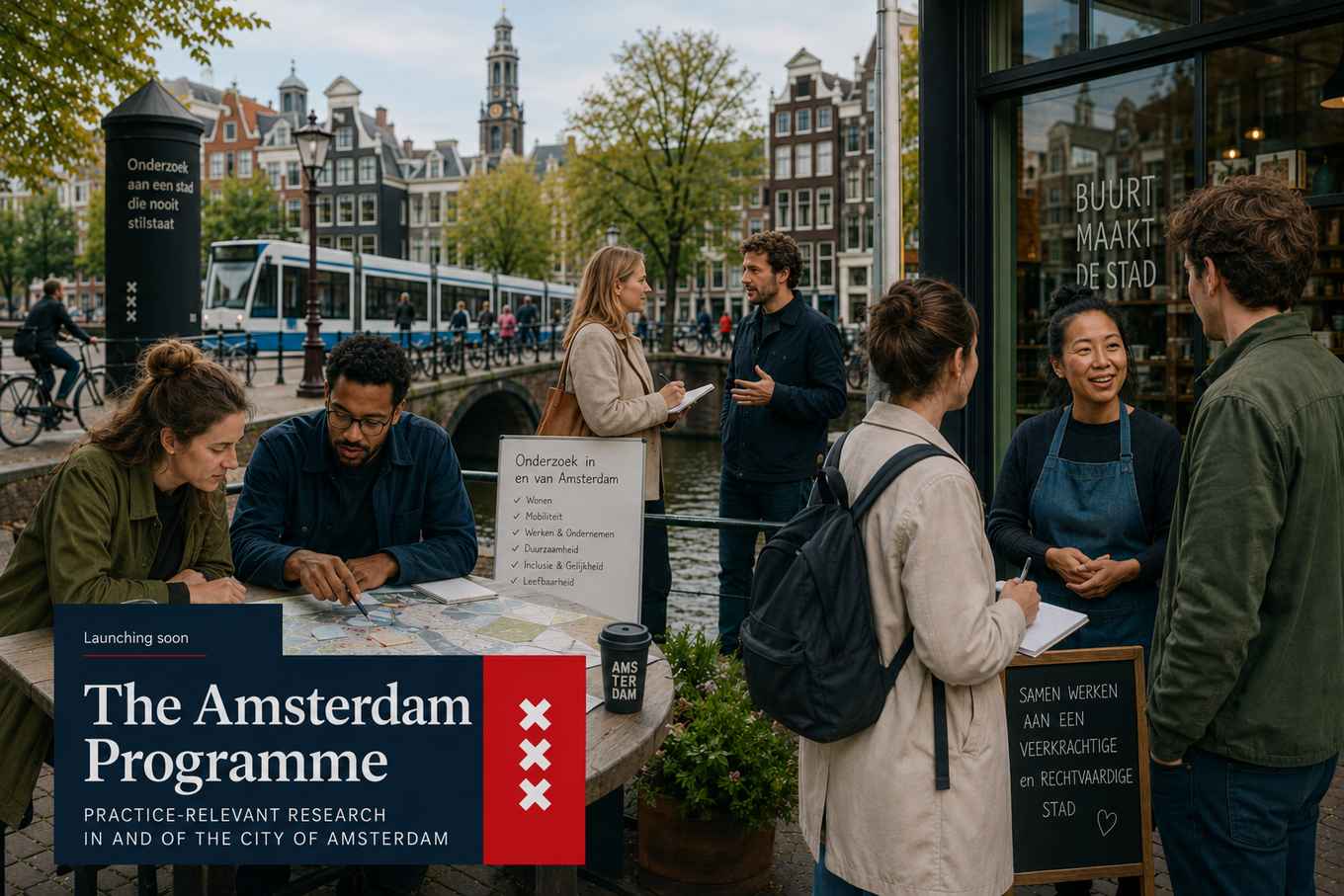
Recruitment for the cohort of eight fully funded PhD positions is open until 1 September 2026. The selected candidates will start on 1 January 2027 and work on research projects that address real-world challenges facing Amsterdam in close collaboration with civic organizations and the Municipality of Amsterdam.
In this interview, we learn more from AISSR Academic Director Justus Uitermark and Doutje Lettinga, Chief Science Officer at the Municipality of Amsterdam, about the vision behind this collaboration, what they are looking for in potential candidates, and the impact they hope the programme will make.
Why Amsterdam needs a new kind of PhD programme
This new PhD initiative represents a substantial investment. Since the programme aligns with the university’s mission to engage with the city, the university board agreed that the AISSR could tap into its reserves to finance it. But Justus emphasizes that the programme also aligns with the institute's profile.
‘This programme grows out of a long tradition of engaged research at the AISSR. It represents a scaling up of that commitment: the size and scope of the programme means that we can train a new generation of scholars to combine fundamental inquiry with practical relevance’.

The size and scope of the Amsterdam programme means that we can train a new generation of scholars to combine fundamental inquiry with practical relevance
Amsterdam as an Urban Laboratory
This programme has an explicit Amsterdam-orientation. From start to completion, the fieldwork and analysis must take place in the city and immediate surroundings. For Justus, however, that does not mean thinking narrowly.
‘Social life doesn’t stop at municipal boundaries. People move between regions every day. Labour migrants, for instance, may not live in the inner city but interact with Amsterdam through work and travel. Some projects will also incorporate comparative elements, looking at other cities and asking what is specific to Amsterdam and what is more general.’
Doutje Lettinga reminds us that cities develop and execute policies. This means that they are fruitful sites for social research that examines challenges faced by individuals, communities and businesses in Amsterdam. ‘The city is where residents encounter institutions in their everyday lives, through public and healthcare services, or flagging something as simple as an unclean street. In that sense, the city becomes a kind of living laboratory - an urban laboratory - where you can study phenomena that have real societal impact’, she says.
Justus agrees: ‘I really like the notion of the Urban Laboratory because it moves away from the classic idea of a laboratory where everything is controlled. In cities, everything is not controlled. Many things happen at once. It’s messy, sometimes even unruly, which also makes it incredibly inspiring to study.’
Bringing research and practice closer together
The collaboration between the AISSR and the Municipality of Amsterdam grew out of a shared ambition: to connect fundamental academic research more closely to questions emerging from the city itself.
Justus approached Doutje with his vision for the Amsterdam programme: funding for eight PhD candidates to conduct in-depth research on urban challenges, explicitly related to the city of Amsterdam, with clear output aims that would be useful to the city and its residents.
After supervisors submitted project proposals, they jointly assessed them through an Amsterdam-oriented lens: are these questions relevant for residents, civic organizations, and the city administration? What types of results could the research yield that could inform policy or practice?
‘That dialogue allowed us to build a strong, coherent portfolio of PhD projects’, says Doutje.
This partnership between the AISSR and the Municipality of Amsterdam represents a continued commitment to bridging the gap between academic research and the realities of urban life. The input from the municipality ensures that projects remain grounded in the real-world challenges in Amsterdam while still being driven by scientific curiosity. It also grants the researchers access to policy departments, data, professionals and communities that would be much harder to achieve without the municipality as a partner.
‘Finally, it allows us to think together from the start about how research can translate into impact and action: how findings can be taken up in policy and practice, not as an afterthought but built into the design of the projects’, the Chief Science Officer concludes.

The city of Amsterdam is a kind of urban laboratory where you can study phenomena that have real societal impact
Academic excellence with societal engagement
Although the programme emphasises practice-relevant research, both Justus and Doutje are clear: this is a rigorous academic program that first and foremost prioritizes scientific inquiry.
By asking researchers to move their work into the hustle and bustle of urban life, the candidates of the Amsterdam programme will be required to actively interact with the city beyond passively ideating about it. “We also call this city science: practice-based, interdisciplinary, urban research produced with a variety of city actors and used in real time”, Doutje says. That means working with policymakers, professionals, civil society organisations, community groups and residents. Candidates will co-design research questions where appropriate, share interim findings and test interpretations along the way.
Profiles differ by project, so prospective candidates should carefully read the individual vacancies to see where their skills and background best fit. Across all projects, however, the ideal candidate combines academic rigour with strong social skills, reflecting the programme's emphasis on relationship building, networks and participation.
For Justus, intellectual ability alone is not enough. ‘We need practical intelligence, too’. In his eyes, the ability to smoothly and conscientiously navigate between different social and professional milieus is essential: ‘These different sensitivities - analytical, social - are equally important.’
Interested in joining an exciting new cohort of junior researchers? Learn more about the specific projects and supervisors here:
- PhD Position Urban Utopias and Urban Policy in Amsterdam
- PhD Position Navigating Labour and Housing Precarity in Amsterdam
- Two PhD Positions in Anthropology on Urban Issues in Amsterdam
- PhD Position Negotiating Democracy in Amsterdam
- PhD Position Strategizing for the Green Transition in Amsterdam
- PhD Position The Rule of Law from Below
- PhD Position Local Democracy and Underrepresented Communities in Amsterdam
Please note that applicants should check the language requirements carefully, as most positions require proficiency in Dutch.
Application deadline for all positions: 1 September 2026