Academic Outsider: Who Gets to Belong in the Academy?
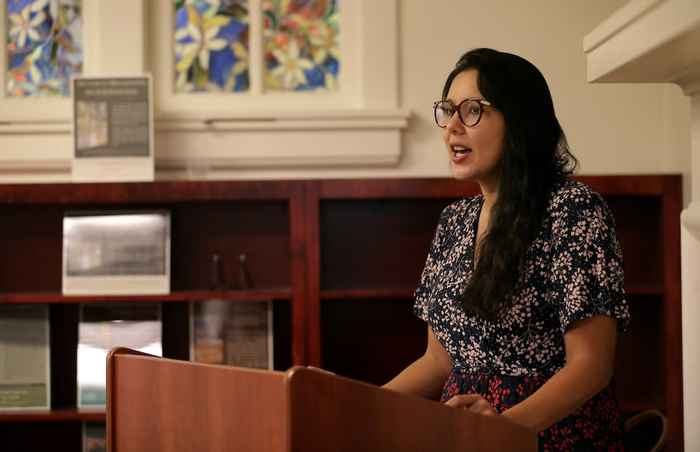
The lecture hall fell quiet as Dr. Victoria Reyes posed a disarmingly simple question: “Who is disposable in the academy?”
23 March 2026
Academic Justice and Conditional Belonging
Reyes began by reflecting on the COVID-19 pandemic as a moment of revelation. The pandemic laid bare how unevenly vulnerability is distributed, also within academia itself. Care responsibilities, immigration precarity, racialised inequalities and gendered expectations did not affect all scholars equally. The crisis made visible what had always been present: that participation in academic life is rarely unconditional.
From this observation, Reyes introduced the concept of “academic justice”. Academic justice, as she framed it, would mean the ability to partake in academic life without having to conform to the norms of whiteness, patriarchy, or a narrow canon of “legitimate” knowledge. Yet the dominant logic of the contemporary university – what she described as a “publish or perish” culture – mirrors broader capitalist imperatives of competition and extraction. Success is measured in outputs, grants, and prestige, and survival often depends on how close you are to institutional power, in other words academic “insiders”.
The author also spoke candidly about her own upbringing - shaped by violence, precarity, and a sense of rootlessness – and about how histories of violence and marginalisation often mark the lives of women positioned at the margins of institutions. She noted how such experiences rarely enter academic spaces as recognised forms of knowledge. Instead, they are frequently discounted and framed as subjective or political, stripped of intellectual legitimacy.
This dismissal is part of what Reyes described as the emotional and intellectual violence of the academy. Institutions that present themselves as offering refuge to marginalised scholars can simultaneously extract disproportionate labour: additional mentoring, diversity work, bureaucratic navigation, and the constant negotiation of microaggressions. Reyes reminds us that academic outsiders often live as conditional citizens within the university apparatus: present, productive, yet never fully secure.
Love as Capital: Rethinking What the Academy Values
At the heart of Reyes’ lecture was a striking conceptual reframing: love as a form of capital. As she explained, love is not merely a private emotion but a culturally mediated currency. It manifests as things like care and attention, and it is unevenly distributed. What the academy “loves” shapes what it funds, celebrates, and cites. What is valued as high-quality scholarship is not neutral, but sustained by insiders who define the standards.
Drawing on traditions of Black feminist sociology and thinkers such as bell hooks, who defined love as “the will to nurture our own and others’ spiritual growth”, the researcher suggested that reimagining the academy requires more than policy reform. It requires a reorientation of values. If the university is currently built on ego and competition – on the relentless pursuit of grants, awards, and tenure – what would it mean to organize a life around collective flourishing instead?
This question becomes even sharper as Reyes closed with a broader reflection: What is careerism when people are living through genocide, stripped of reproductive rights, or enduring authoritarian regimes? In a world marked by profound injustice, what does it mean to devote ourselves uncritically to individual advancement?
From Critique to Collective Practice
The discussion that followed turned toward practice. How, participants asked, might we collectivize under conditions that reward competition? Reyes was clear-eyed: The institution will never save us. Change must begin from the bottom up. In peer review, how do we evaluate one another’s work? In teaching, how do we navigate power dynamics in the classroom? How do we make conscious efforts to celebrate colleagues’ successes rather than silently competing with them?
Echoing the writer Rebecca Solnit and Mariame Kaba, she reminded the audience that hope is not naïve optimism, but a discipline tied to action. It requires daily, embodied choices. Even the energy we bring into academic spaces matter: what emotions we externalise, how we inhabit honesty, and whether we allow space for a certain radical “wildness”.
Dr. Reyes talk did not offer easy solutions. Instead, it left the audience with a challenge: to examine the conditions under which we work, teach and produce knowledge, and to ask who those conditions serve. If belonging in the academy remains conditional, then academic justice demands more than inclusion within existing hierarchies. It demands that we rethink the hierarchies themselves.
Who, then, is disposable in the academy? And what would it take to refuse disposability – not only in principle, but in practice?