Why Nuclear Energy Cannot Be a Solution to the Climate Crisis
1 May 2026

The answer presented throughout the lecture was clear, evidence-based, and deeply challenging to dominant narratives. However, the topic is still not free from discussion.
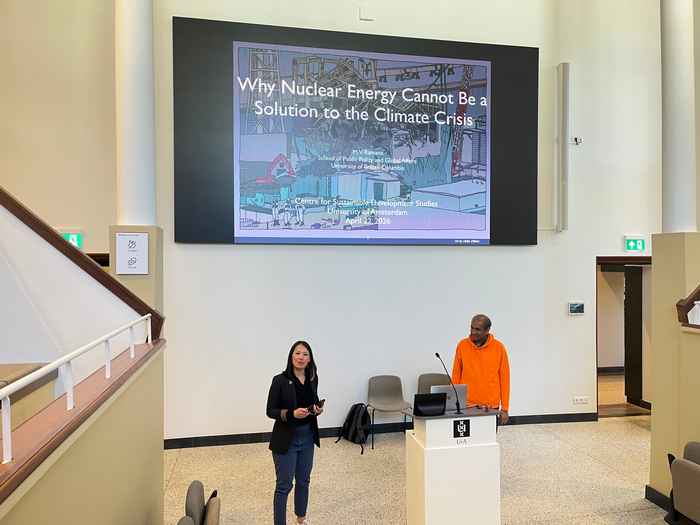
Professor MV Ramana, Simons Chair in Disarmament, Global and Human Security at the University of British Columbia, opened by questioning the increasingly common portrayal of nuclear power as a straightforward low-carbon solution. While nuclear energy is often framed as clean and necessary, he argued that this narrow lens ignores the broader economic, temporal, environmental, and geopolitical realities that shape energy systems. Climate action, he insisted, cannot be reduced to carbon metrics alone.
Problem Statement
One of the central themes of the lecture was that responding to climate change requires reducing emissions at the lowest cost and in the shortest possible time. This means evaluating technologies not only by whether they emit carbon during operation, but also by whether they can be deployed rapidly, affordably, and at scale.
Ramana showed that nuclear power performs poorly on these criteria. Globally, the share of electricity generated by nuclear energy has declined significantly from its historic peak in the 1990s. At the same time, the construction of new reactors has become slower and more expensive. Large-scale projects in France, the United Kingdom, and the United States were cited as examples of dramatic cost overruns and prolonged delays. Rather than representing a fast-track climate solution, many recent nuclear projects have consumed decades and billions in public resources.
The Massive Costs of Nuclear Expansion
The lecture also explored why nuclear energy struggles economically in increasingly competitive energy markets. Ramana compared the cost of nuclear-generated electricity with alternatives such as solar and wind, noting that renewable technologies have fallen sharply in price while nuclear construction costs have continued to rise.
This economic gap matters politically. Every euro invested in expensive and slow infrastructure is a euro not invested in faster and more cost-effective decarbonisation pathways such as renewable generation, storage, efficiency, and grid modernisation. In that sense, the issue is not simply whether nuclear power can generate low-carbon electricity, but what opportunities are lost when it is prioritised.
Beyond Economics: Risk, Waste, and Security
The lecture moved beyond markets and engineering to examine risks that are often marginalised in climate debates. Nuclear accidents, though infrequent, can carry immense long-term social and economic consequences. Fukushima was cited as a reminder that low-probability events can still generate staggering costs and disruption. Equally significant was the unresolved issue of radioactive waste. Nuclear power continues to generate materials that remain hazardous for millennia, while no universally demonstrated long-term disposal solution exists. This raises ethical questions about passing burdens to future generations.
Ramana also addressed the close historical and institutional relationship between civilian nuclear programmes and nuclear weapons development. In a period of renewed geopolitical tension, he warned that expanding nuclear infrastructures cannot be separated from questions of proliferation, militarisation, and global insecurity.
Perhaps the most compelling part of the session concerned why nuclear power continues to be promoted despite these limitations. Ramana suggested that the answer lies in political economy rather than technical merit. Nuclear projects often attract support because costs and risks are socialised through subsidies, state guarantees, and liability protections, while profits remain concentrated among corporations and contractors.
This perspective encouraged participants to rethink climate transitions not simply as technological shifts, but as struggles overpower, public money, democratic accountability, and competing visions of the future.
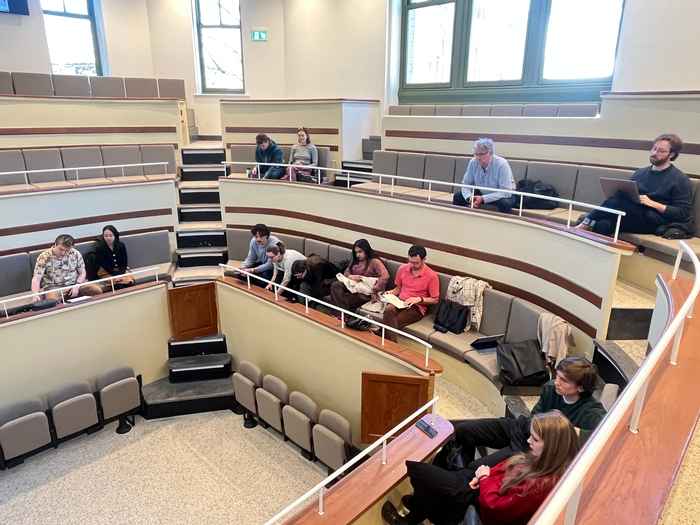
The discussion that followed reflected the depth of interest generated by the lecture. Participants raised questions on energy justice, European policy, state subsidies, and the future of renewable systems. The atmosphere was engaged and reflective, with many attendees continuing conversations after the event.
Rethinking Climate Solutions
The lecture concluded with a powerful reminder: solving climate change is not only about replacing one energy source with another. It requires transforming the systems of ownership, inequality, and decision-making that created the crisis in the first place.
Rather than seeing nuclear energy as an inevitable answer, Ramana invited the audience to ask a deeper question: what kinds of energy futures are fast, fair, democratic, and genuinely sustainable?