Turning (Far) Right? Populism and Electoral Cycles in Latin America
Roundtable co-organised by CEDLA and Political Science
- Date
- 9 October 2026
- Time
- 15:00 -17:00
- Location
- BG 3
- Room
- VOX-POP, Binnengasthuisstraat 9
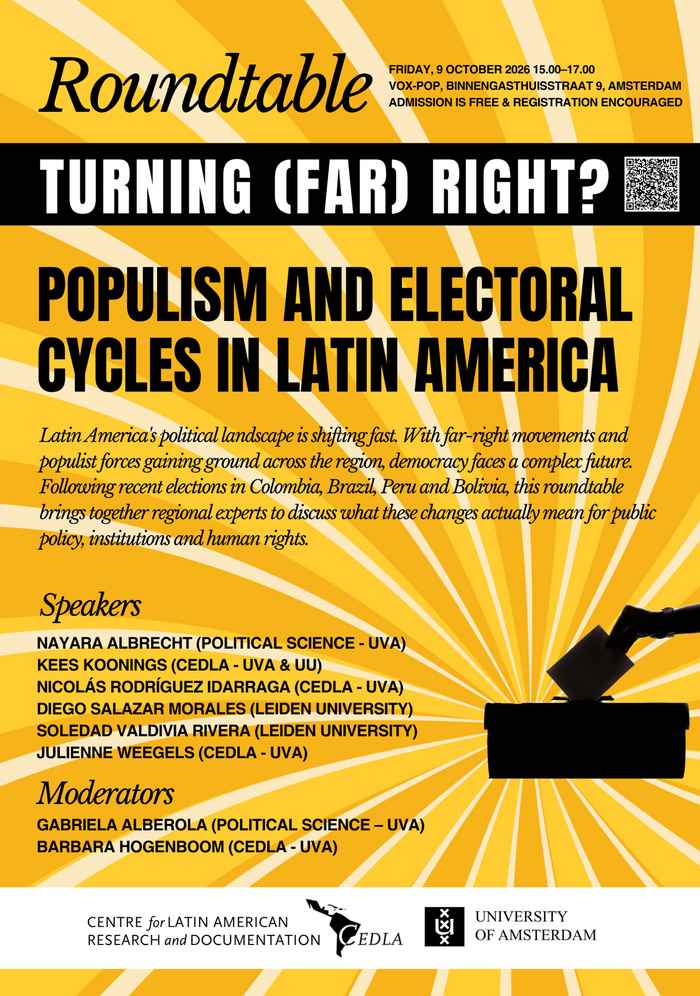
Drawing on recent developments in countries such as Colombia, Brazil, Peru, and Bolivia, speakers will discuss common trends and differences in populism and electoral cycles, and reflect on possible futures for democracy in Latin America.
Right is on the rise
This year - which started with the US intervention in Venezuela - has seen presidential elections in Costa Rica, Bolivia, Peru and Colombia, and soon also in Brazil. Despite differences and often very tight margins, the latest results confirm the region’s political trend of the past few years: right-wing parties and far-right movements and politicians are on the rise. This raises questions about the nature, causes and effects of the latest regional political cycle. While Latin America has often seen alternating phases of left‑wing and right‑wing governments, and alternation in power can be healthy for democracies, the rise of the (far) right has often been followed by policies that reduce public services, by conservative discourses targeting women, indigenous, black and/or queer people, and by setbacks in civil rights. More recently, the expansion of far-right populism has been fuelled by social media, fake news and support from foreign powers.
Electoral and political trends in Latin America
This roundtable will discuss electoral and political trends in Latin America, with particular attention to how recent elections reshape ideological conflicts, deepen political polarisation, and affect democracy. Each country expert will offer a brief presentation, followed by a general discussion with the audience on the region’s possible futures.
How to register
Registration is encouraged, but walk-ins are welcome. Please register here if you want to receive an invite and a reminder.